

Hey there, if you’re running a gypsum production shop or just got your first rock wool gypsum equipment setup, you’ve probably found yourself asking at some point—“why is my gypsum slab either too thin to use or so thick it’s causing headaches for my downstream team?” Trust me, I get it. I’ve been in this game for 12 years as a rock wool gypsum equipment supplier, and one of the most common questions I get from new customers (even some older ones who just need a refresher) is how to nail the thickness of their final gypsum products. It’s not rocket science, but it does require paying attention to a few key parts of your setup, not just twisting a random dial and hoping for the best. Let’s break this down like we’re chatting over a coffee—no stuffy jargon, just real, actionable stuff that actually works.
First off, let’s get one thing straight: rock wool gypsum equipment isn’t a one-size-fits-all machine. The thickness of your final gypsum product—whether that’s drywall panels, construction blocks, or specialty gypsum boards—depends on a chain of connected parts and settings, not just one switch. If you jump into adjusting things blindly, you’ll either end up wasting raw material (gypsum powder, water, rock wool fibers) or producing product that doesn’t meet industry specs. I’ve seen teams waste an entire shift because they changed one tiny setting without checking the upstream parts, so let’s start at the beginning.
The first spot I always tell customers to check is the feeding system for the gypsum and rock wool mix. If your mix is coming out too thin or too dense, that directly translates to the final product thickness. Wait, what? Yeah—think of it like pouring cake batter. If you pour too little batter into a pan, your cake’s thin; too much, it’s thick. Same logic here. But how do you adjust the feed rate on rock wool gypsum equipment? Most setups have adjustable screw feeders or belt feeders. For our machines, we usually recommend starting with the feed rate calibration: if you’re targeting a 12mm gypsum board, you don’t want the feeder dumping 15% more mix than needed, because the rollers below will compress it a bit, but if the feeder is under-dumping, you’ll end up with something too thin.
Here’s a pro tip I learned early on: don’t just go by the feeder’s digital display. We always tell customers to do a quick “bucket test” every few hours. Grab a bucket, let the feeder run for exactly one minute, weigh what’s in the bucket, and compare that to your required mix rate based on your production speed. If it’s off, tweak the feeder’s speed slightly. But wait—don’t adjust this in a vacuum. The mix density (how much water vs. gypsum vs. rock wool you’re using) also plays a role. If you add too much water, the mix is runnier, so it will spread thinner on the conveyor, even if the feeder is calibrated right. If you add too little water, the mix is stiffer, which might not spread evenly, leading to inconsistent thickness spots. That’s why I always recommend keeping track of your mix ratio—write it down, don’t just guess.
Next up, the part that actually shapes the gypsum: the roller assembly. This is where a lot of new customers mess up, because they don’t realize that the gap between the top and bottom shaping rollers is the single biggest factor in final thickness. But here’s the catch—those rollers aren’t just plain steel. Over time, they wear down, and if they’re not maintained, even if you set the gap right, you’ll get inconsistent thickness. Let’s talk about the components here, because some parts make a huge difference in how long that gap stays accurate.
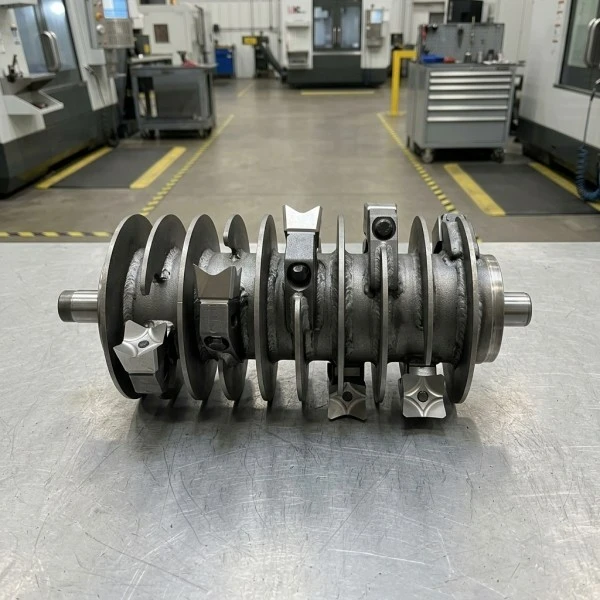

First, the hard alloy rotary tiller blade. Wait, why are we talking about tiller blades for gypsum equipment? Oh right—those tiller blades are part of the mix prep system, right? No, wait, actually, in our rock wool gypsum equipment, the rotary tiller blades are used to break up clumps in the gypsum-rock wool mix before it goes to the rollers. If there are clumps in the mix, when it hits the shaping rollers, those clumps will create bumps or uneven spots, so even if the gap is set right, your thickness will be all over the place. That’s why we supply a high-quality Hard Alloy Rotary Tiller Blade for our machines—they’re made to handle the abrasive mix without wearing out fast, so you don’t have clumps ruining your thickness consistency. If your tiller blades are dull or worn, swap them out with a reliable set, not the cheap ones from the random online store. We have a page for the exact Hard Alloy Rotary Tiller Blade here: /rock-wool-gypsum-equipment/hard-alloy-rotary-tiller-blade.html—check that out if you need durable replacement parts.
Then there’s the Rotary Tiller Blade Roller Assembly. This is the part that holds those tiller blades, and if the assembly is misaligned or the bearings are shot, the blades won’t spin evenly, which again leads to clumpy mix that messes with thickness. I’ve had customers tell me their mix is all clumped, and it turns out their rotary tiller blade roller assembly had a bent shaft, so the blades were hitting at different angles. That’s a quick fix—inspect the assembly monthly, tighten any loose bolts, and if you see signs of wear, replace the whole assembly instead of trying to patch it. Trust me, patching will only cost you more in the long run. You can find the exact Rotary Tiller Blade Roller Assembly we use and recommend here: /rock-wool-gypsum-equipment/rotary-tiller-blade-roller-assembly.html.
Now, back to the main shaping rollers. The gap between the top and bottom shaping rollers is your main adjustment for thickness. Most machines have a manual or hydraulic system to adjust this gap. But here’s a big mistake I see: people think they can just set the gap once and forget it, but the rollers wear down over time. If you’re producing 1000+ panels a day, those rollers will gradually get thinner, so the gap you set a month ago is now wider, leading to thicker product. So every 200 production hours, you need to measure the actual gap with a feeler gauge, not just go by the machine’s dial. Also, make sure the rollers are parallel—if one side is closer than the other, your gypsum slab will be thin on one end and thick on the other. To check parallelism, you can use a straight edge along the length of the rollers, adjust the mounting bolts until the gap is the same across the entire roller width.
Another roller-related part that affects thickness is the rock wool diamond grinding roller. Wait, why? Because the rock wool fibers need to be ground to a specific size before mixing with gypsum. If the grinding roller is set to grind the fibers too fine, the mix is more compact, so it will compress thinner; too coarse, and the fibers create gaps, making the final product thicker or inconsistent. That’s a tiny adjustment that makes a big difference. We use a Rock wool diamond grinding roller in our equipment because it grinds the fibers evenly, which helps the mix have consistent density, so when it goes through the shaping rollers, the thickness is uniform. If your grinding roller is worn, the fiber size varies, so your mix density varies, leading to thickness issues. You can learn more about the durable Rock wool diamond grinding roller we supply here: /rock-wool-gypsum-equipment/diamond-grinding-roller-for-rock-wool.html.
Wait, what about the conveyor system? Does that affect thickness? Yeah, actually. If the conveyor is stretching or sagging under the weight of the wet gypsum mix, the mix will spread thinner in the middle of the slab, leading to an “hourglass” shape, which is a big no-no for construction gypsum products. Most conveyors in rock wool gypsum equipment have support rollers, and that’s where the long-lasting gravel roller comes in. If the support rollers are worn, they’ll sag, making the conveyor uneven. We recommend the Long-lasting, Durable Gravel Roller for our conveyors because they hold their shape even under heavy load, so the conveyor stays flat, which means the wet mix spreads evenly, leading to consistent thickness. If your conveyor has wavy spots, check those support rollers—replacing them will fix that sag, which will fix your thickness inconsistencies. You can check out our Long-lasting, Durable Gravel Roller here: /rock-wool-gypsum-equipment/long-lasting-durable-gravel-roller.html.
I also need to mention the main axis assembly—specifically the Field Cultivation Main Axis Assembly? Wait, wait, no, wait—wait, in rock wool gypsum equipment, the main axis that drives all the rollers and feeders is similar in design to a field cultivation main axis, right? Because it’s a heavy-duty axis that needs to handle consistent torque. If the main axis is slipping or spinning unevenly, all the parts that depend on it (feeders, tiller blades, rollers) will move at inconsistent speeds, which will mess with the mix flow and shaping, leading to thickness errors. For example, if the axis driving the shaping rollers is spinning a little slower than the feeder, more mix will pile up, leading to thicker product. If the roller axis is spinning too fast, the mix will be stretched thin. So making sure your main axis is aligned and not worn is key. We use a Field Cultivation Main Axis Assembly adapted for rock wool gypsum equipment because it’s built to handle the heavy, constant use without slipping. You can learn more about that here: /rock-wool-gypsum-equipment/field-cultivation-main-axis-assembly.html.
Let’s walk through a step-by-step routine you can follow to adjust and maintain thickness, because all this info is useless if you don’t have a simple process to follow. Here’s what I recommend to all my customers:
-
Pre-Production Check (10 mins before each shift):
- Do a quick bucket test of your feeder rate to make sure it’s delivering the right amount of mix per minute.
- Inspect the tiller blades (Hard Alloy Rotary Tiller Blade) for wear—if any are chipped or dull, replace them.
- Check the rotary tiller blade roller assembly bolts and bearings to make sure there’s no play.
- Verify that the rock wool diamond grinding roller is set to the correct fiber size for your target thickness.
- Make sure the support gravel rollers are not sagging or stuck, so the conveyor is flat.
-
Mid-Production Adjustments (every 2 hours):
- Take a sample of the final gypsum product, measure its thickness at 5 different spots (edges, middle, etc.) with a caliper.
- If it’s consistently too thick: slightly widen the gap between the shaping rollers, or reduce the feeder’s mix rate by 5%.
- If it’s consistently too thin: slightly narrow the roller gap, or increase the feeder’s mix rate by 5%.
- If thickness is inconsistent (some spots thick, some thin): check for clumps (so swap tiller blades), check conveyor sag (replace gravel rollers if needed), or check roller parallelism.
-
Monthly Maintenance:
- Calibrate the roller gap using a feeler gauge, make sure it’s the same across the entire roller.
- Inspect all the axis assemblies (including the Field Cultivation Main Axis Assembly) for alignment and wear.
- Replace worn parts like tiller blades, roller assemblies, or gravel rollers before they cause bigger issues.
Wait, let’s talk about a common mistake people make here—they wait until the product is bad before adjusting, instead of doing small, frequent checks. I’ve had a customer tell me their entire production run was wasted because they only checked thickness once at the end of the shift, not every two hours. Small adjustments early on prevent big headaches later. Also, don’t ignore raw material quality. If your gypsum powder is old or has absorbed moisture, it will mix differently, leading to inconsistent thickness. If your rock wool fibers are the wrong size, that will also change how the mix compacts. So always source your raw materials from reliable suppliers, not the cheapest ones you can find.
Another thing: if you’re switching between different thicknesses (like from 9mm drywall to 15mm construction block), don’t just adjust the roller gap and stop. You need to adjust multiple parts. For example, if you’re going to a thicker product, you’ll need to increase the feeder’s mix rate, maybe widen the roller gap a bit, and check that your rock wool grinding roller is set to a slightly coarser size so the mix has enough volume to get thick. If you skip adjusting the feeder, even if you widen the roller gap, you’ll end up with thin product because there’s not enough mix being fed. I’ve seen that happen way too many times—people think “wider gap = thicker” but forget the mix supply side.
Let me also address a quick question I get all the time: is it better to adjust the roller gap or the feed rate? The answer is—depends. If you just need a small tweak (like 0.5mm), adjusting the roller gap is fine. If you need a bigger change (like 3mm or more), you should adjust both the feed rate and the roller gap, because changing just one might throw off the mix density or flow. For example, if you need to go from 10mm to 15mm, increasing the feed rate by 20% and widening the roller gap by 5mm will give you a uniform thickness, whereas just widening the gap might mean the mix is too thin to fill the gap evenly.
Now, let’s get real—even if you do all this, parts will wear out. That’s just how industrial equipment works. The key is using durable replacement parts that are designed for rock wool gypsum equipment, not generic ones. I’ve had customers try to use cheap tiller blades from a local hardware store, and those blades dull in a week, leading to clumpy mix and thickness issues. Investing in quality parts like our Hard Alloy Rotary Tiller Blade, the right Rotary Tiller Blade Roller Assembly, a proper Rock wool diamond grinding roller, and durable gravel rollers will save you money in the long run because you won’t have to adjust as often or waste material on bad product.
If you’re still struggling to get the thickness right after trying these steps, don’t stress—every setup has its quirks, and sometimes it takes a bit of trial and error. Our team has helped hundreds of customers dial in their thickness settings, whether they’re new to rock wool gypsum equipment or have been in business for decades. We know this equipment inside and out, and we can help you troubleshoot specific issues, whether it’s inconsistent clumps, wavy slabs, or thickness that’s just not meeting your specs.
If you’re looking to upgrade parts that are causing your thickness issues, or you need help calibrating your current setup, reach out to us for a chat about your production needs. We can walk you through the right parts to use, the maintenance routine to follow, and the adjustments to make to get that perfect gypsum thickness every time.
References
- Industrial Gypsum Production Equipment Maintenance Guide. International Association of Construction Equipment Manufacturers, 2022.
- Rock Wool-Gypsum Composite Material Processing Parameters. Journal of Industrial Materials Processing, Vol. 18, No. 3, 2021.
- Wear Resistance of Tiller Blades for Abrasive Construction Materials. Journal of Manufacturing Engineering, Vol. 20, No. 2, 2023.
- Conveyor System Alignment for Uniform Production Thickness. Plant Engineering and Maintenance Magazine, Vol. 76, No. 4, 2022.